Tianjin university water glider research team made a new breakthrough.
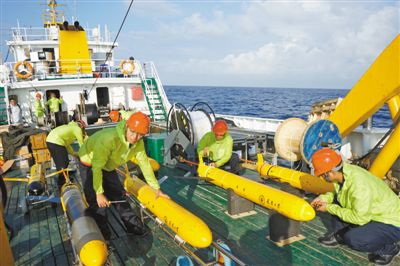
In the two experiments conducted successively in the first half of 2018, Haiyan, which has independent intellectual property rights in Tianjin University, achieved the set goals with superior performance, and achieved a new breakthrough in the working depth and sailing mileage of domestic water gliders — —
In April, the "Haiyan" 10,000-meter water glider dived to 8,213 meters in the waters near the Mariana Trench, setting a world record for the working depth of the water glider;
On May 14th, "Haiyan — L "has been running continuously for 119 days, 862 profiles have been completed, and the sailing mileage is 2,272.4 kilometers, once again setting a new record for domestic underwater gliders, such as the longest continuous working time, the most measured profiles and the longest cruising range.
From the depth of 100 meters in 2005 to 500 meters in 2009 and 8213 meters in 2018, the "Haiyan" research team started from scratch and turned the dream of "asking about the sea" into reality step by step.
More than 10 years of painstaking research, demonstration application "show your talents"
Shaped like a torpedo, it is 2.3 meters long (excluding antenna), 0.22 meters in diameter and weighs about 78 kilograms. Compared with the traditional unmanned cableless submersible (AUV), Haiyan is light and thin.
"Haiyan" of Tianjin University — — The project "Key Technologies and Applications of Hybrid-driven Underwater Vehicle" focuses on a new type of unmanned cableless underwater autonomous vehicle. It combines buoyancy drive and propeller propulsion technology, which can not only achieve the same turning and horizontal movement as AUV, but also have the ability of profile gliding of traditional underwater gliders, and can do zigzag movement.
The world’s first underwater glider was born in 1991. "In 2001, I learned about the research progress of underwater gliders abroad in an article. The demand of marine environment and resource exploration makes the activity ability of underwater robots have to be extended from fixed points to a large range, from shallow sea to deep sea, from short time to all weather, and underwater gliders are an effective means to achieve these goals. So our team focused on the water glider. " Wang Shuxin, Vice President of Tianjin University, introduced.
Plus Wang Shuxin, there were only four or five core members of the team at that time. Due to the strict blockade of this technology abroad, the related research in China is still blank. We should start with the information, and do it ourselves from design to assembly.
"Without funds, we will do research in a small workshop for students to practice and test the water in the Youth Lake of Tianjin University." Wang Yanhui, a professor at the School of Mechanical Engineering of Tianjin University, was a master student at that time, and he has never left this research since he joined the team in 2002.
The cruising range is an important index of underwater unmanned glider, and finding the appropriate energy functional materials is the key. "In order to solve this problem, the project team conducted numerous brainstorming, and the experiment was conducted late at night every day. This state lasted for more than a month, but still nothing was achieved. During that time, everyone was suffering." Wang Yanhui said.
One night, Wang Shuxin had an inspiration: Try a paraffin wax used for the surface of clothes. "Unexpectedly, this is the energy material we have been searching for." Wang Yanhui and others were overjoyed by the test results.
In 2005, the team successfully developed the first generation of water gliders driven by temperature difference energy, with a working depth of 100 meters. In 2009, the second generation hybrid propulsion underwater glider "Haiyan" was successfully developed with a working depth of 500 meters. Also in this year, the team named it "Haiyan", which means that it is as light as a swallow and weather-beaten. "Haiyan" is also a spirit that supports project participants.
In the spring of 2014, Haiyan participated in the mid-term evaluation of standardized sea trials. Under the full supervision of the third party, it successfully completed a series of tasks such as single cycle, multi-cycle and long voyage, and set many records such as the longest trouble-free voyage, the longest time, the most profile movement and the largest working depth of the China underwater glider at that time.
Today, "Haiyan" has taken the lead in "showing its talents" in China’s key marine technologies and demonstration applications, and has been successfully applied to major national projects such as water quality monitoring of the South-to-North Water Transfer Project, environmental investigation in the South China Sea and marine national defense construction.
8213 meters deep sea exploration, Mariana returned with honor.
Mariana Trench is the deepest trench on the earth at present. With the strong support of national ministries and commissions, the "Haiyan" team in 2018 has developed underwater glider products with different depth lineages, such as 200m, 1500m, 4000m and 10000m, making sufficient preparations for going to the Mariana Sea.
2 sets of Haiyan — 1500 "and 1" Haiyan — 4000 "and 1" Haiyan — 10,000 "went to sea at the same time, among which Haiyan — 10000”。 Although all the equipment has been tested in the laboratory, every member of the team still feels a lot of pressure.
“‘ Haiyan ’ Every time we go to the sea, our mood is as anxious as waiting for our children to return safely. " Wang Yanhui said, "Typhoon, undercurrent and great pressure on the seabed that may be encountered in the sea trial are of great significance to ‘ Haiyan ’ It is a challenge. "
"Sometimes, even if it comes back an hour or two late, it is a huge suffering for us." Yang Ming, a doctoral student of the research group and born in 1992, went to sea with Haiyan when he was doing his undergraduate graduation project four years ago. In his memory, the most worrying one was Haiyan — 4000 "is two hours later than the expected" home "time. "Everyone is hanging a heart, eagerly waiting for the computer to send ‘ Haiyan ’ The signal of returning. " Yang Ming said.
Internationally, it is not uncommon for water gliders to "get lost" in the experiment, but it is a real "needle in a haystack" to find them back. Worried about "Haiyan" getting lost, Li Haozhang, a 27-year-old doctoral student of the research group, even created a set of algorithms to estimate the possible position of the water glider within a few hours of its loss. Although this algorithm has not had a practical opportunity in Haiyan, which has a 100% recovery rate, in an experiment, the submersible of other teams was "accidentally" recovered.
"In the Mariana waters, five of us are on duty in turn. When the ship’s equipment is received ‘ Haiyan ’ We were all very excited when the signal came out of the water and marked its latitude and longitude position at that time. " Yang Ming said. After the scientific research ship recovered Haiyan, everyone downloaded the data it brought back at the first time. When the depth was 8213 meters, the whole team was boiling.
The average age is 39 years old, and more young people dream of the deep sea.
Yang Shaoqiong, a lecturer at the School of Mechanical Engineering of Tianjin University who joined the Haiyan team in 2017, found that this team with an average age of 39 was very different. Everyone seems to have a kind of spiritual strength, even if he works for more than ten hours every day, spends more than 100 days in the field every year, and often "floats" at sea, he has no complaints; They have strong hands-on ability. One person stands on the second deck to command, one person controls the crane, one person sets the net, and one person controls the cable, hooking, lifting, laying, unhooking and entering the water, all of which are "good hands"; They are hands-on, very serious, and they all feel "not practical" if they don’t do an experiment once … …
Being attacked by sharks, encountering dolphins, and helping the captain to repair the ship, they all experienced it in Wang Yanhui. Because of limited funds, they also gave up two or three thousand tons of scientific research vessels and rented small fishing boats. In 2013, when doing experiments in the South China Sea, the fishing boat broke down just after 20 or 30 nautical miles, and the deck began to enter the water. At that time, it was about 12 o’clock at night. Wang Yanhui and others were watching the test data of Haiyan while scouring the water to save themselves. "It’s quite scary to think about it now, but fortunately, the rescue boat arrived soon." In order not to delay the progress of the experiment, in the early morning, Wang Yanhui and others rented another fishing boat to go to sea.
"Haiyan — The research, design, manufacture, assembly and testing of the 10000 "water glider took less than one year. In order to catch up with the time, team members Niu Wendong, Lan Shiquan, Shao Lai, Li Yucong, Sun Chao, Mi Deyuan, Wang Chao, Sun Tongshuai, Lu Faliang and Cui Chenming often worked in the laboratory until 12 pm. In order to ensure the success of the sea trial, Li Haozhang, Zhang Shihe and Bai Yongmin persisted in their work during the Spring Festival, completed the assembly of the energy module and the control module, and set up several sets of automatic test systems, which can test multiple devices at the same time by one person.
"Depart from Qingdao to the sea near Mariana Trench, and typhoon ‘ Hide and seek ’ I walked hundreds of miles, but the ship was still shaking so badly that people couldn’t stand on it and things were scattered all over the floor. Even an old crew member like me who goes to sea every year is extremely uncomfortable. " Wang Yanhui said that most of the team that went to sea with him this time were young people born after 1990s, and they were even more seasick and unable to get to the station.
With its flexible and compact posture, "Haiyan" can follow marine animals for a long time, dance with whales and obtain data. It can also become a "Transformers" on the seabed by expanding professional instruments such as acoustics and optics, and show its talents in the field of ocean observation and detection. In 2017, 12 "Haiyan" aimed at the "mesoscale vortex" phenomenon, which lasted for nearly two months, successively formed a team and cooperated to form a network, and obtained the hydrological data of the typhoon transit sea area for the first time.
China Oceanographic Society and China Pacific Society have selected "Top Ten Scientific and Technological Progress in China Ocean", among which "Haiyan" water glider ranks. "Our technology is constantly improving, and our dreams have become a reality little by little. This is the greatest pleasure and reward of our work." Wang Shuxin said.