US Department of Defense research reveals that bullets will turn and soldiers will "transform" into Spider-Man

Our reporter Liu Xia comprehensive foreign news
DARPA has been engaged in the most important scientific and technological research, and its achievements have attracted worldwide attention. For example, the well-known major inventions such as the Internet, Global Positioning System (GPS) and stealth fighter are all due to DARPA. Moreover, DARPA is currently developing technologies related to military or intelligence systems, which can not only "show their talents" on the battlefield, but also be expected to exert a significant influence outside the battlefield.
In a recent report, the American Business Insider website listed 15 amazing cutting-edge technologies that DAPRA is currently carrying out, including bullets that can change direction in flight, high-energy lasers, flying trucks and so on.
A bullet that turns
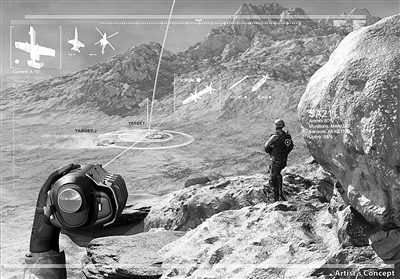
The "EXACTO" project is the first bullet that can aim automatically. EXACTO bullet can change its direction and path with the movement of the target in flight, and overcome the influence of factors that lead to bullet deviation.
DARPA said that the optical probe on the bullet can detect the laser on the target, and then the heat sink on the bullet can guide the bullet to the laser, so as to achieve accurate aiming. This kind of bullet can improve the combat effectiveness of snipers and ensure the safety of soldiers by increasing the range and shortening the engagement time. The Ministry of National Defense has successfully conducted live-fire shooting experiments. It is reported that at present, DARPA has invested 25 million US dollars in the EXACTO project.
High-energy laser capable of destroying missiles
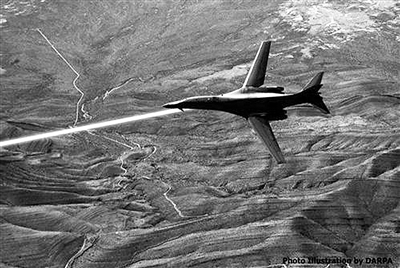
The HELLADS project is an ambitious project. Its goal is to develop an airborne high-energy laser weapon with a volume of less than 3 cubic meters and a weight of less than 5 kilograms and a power of 150 kilowatts. It is a laser weapon suitable for being installed on bombers, transport planes or aerial tankers, and can destroy surface-to-air missiles aimed at aircraft.
Generally speaking, the speed of surface-to-air missiles exceeds the speed of the aircraft they want to attack, so it is difficult for aircraft to avoid missile attacks. The HELLADS system tries to shoot down missiles with lasers. The speed of high-energy laser makes it superior to most conventional weapon systems and ammunition. Laser travels at the speed of light, and it takes almost no time from launching to having an impact. Because of "zero flight time", high-energy laser can affect the target immediately after correct judgment. Another significant advantage of high-energy laser is its long-distance accuracy.
Milestones of the project include a ground test in 2011 to shoot down two SA-10 surface-to-air missiles at the same time, and a similar aerial test in 2012 and 2013. These tests will promote the development of high-energy laser weapons for combat defense beyond military applications.
DARPA also plans to further enhance the performance of HELLADS laser, making it an offensive weapon that can destroy enemy ground targets.
The common obstacles that must be overcome in developing high-energy laser weapons are cost, anti-laser defense and collateral damage. DARPA said that none of these obstacles are insurmountable.
Flying truck
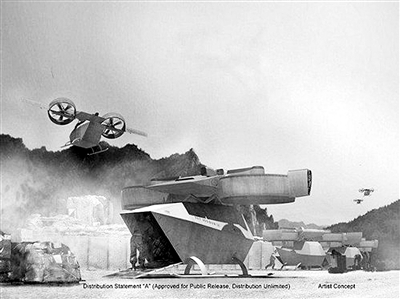
ARES (Reconfigurable Embedded System in the Air) is an unmanned transportation tool being developed by DARPA. It is actually a flying truck, which can change the corresponding modules for different tasks: reconnaissance, personnel or cargo. The system has mobile and multipurpose vertical take-off and landing capability, which provides flexible transportation for more small troops without being restricted by terrain factors, and can deliver goods to hard-to-reach areas faster and more effectively and provide other key services.
ARES will have a dual mode, which can not only travel at high speed on the ground, but also take off and land vertically at high speed. DARPA hopes that ARES can deal with improvised explosive devices and avoid air threats, such as air-to-air missiles.
"big dog" robot
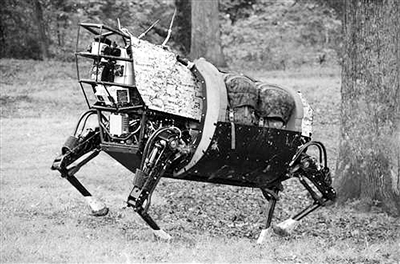
The "Robot Animal Support System" (LS3) project proposed by DARPA and being developed by Boston Dynamics Company aims to develop a semi-autonomous robot with high mobility and four legs, which is mainly used to carry heavy loads for soldiers in the battlefield. Founded by scientists from Massachusetts Institute of Technology, Boston Dynamics specializes in developing robots that move like animals.
The "big dog" robot can follow the infantry through rugged terrain, and can follow the soldiers in complex terrain such as Woods, rocky land, obstacles and urban areas. It is similar to a trained animal, and may also have the ability to maneuver at night, which can become a mobile auxiliary power supply for troops, so that troops can charge the batteries of radios and handheld devices when patrolling.
A computer is installed inside the "Big Dog" robot, which can adjust its walking posture according to the change of environment. A large number of sensors can ensure that the operator can track the position of the "big dog" in real time and monitor its system status.
At present, the "big dog" robot can go to 70% of the places where troops March & mdash; In 80% places, the developed model can carry hundreds of pounds of load, which can greatly reduce the burden on soldiers. The "big dog" robot is currently being tested by the US Marine Corps in Hawaii. In the next task, it will also carry out important water delivery tasks to solve the water shortage problem of the army in complex terrain without water sources. Moreover, in order to reduce the risk for the combatants in the battle, DARPA asked Boston Dynamics to design and manufacture a "big dog" robot with better mute performance and bulletproof performance.
Intelligent sight
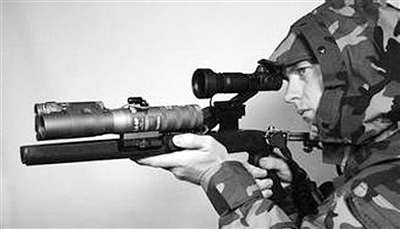
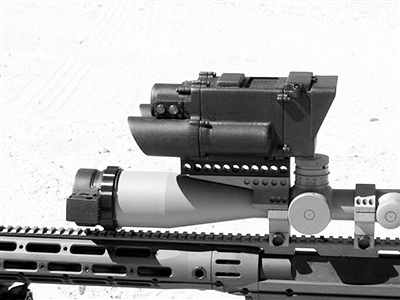
DARPA’s "One Shot" XG project aims to develop a computing system that can be installed on the barrel or sight to improve the shooting accuracy and hit rate of snipers, so as to maximize the operational performance of current and future weapons.
The intelligent sight is equipped with a computing system based on Linux on the barrel or sight, which can calculate many variables such as wind speed, moving obstacles, maximum killing range of weapons, and provide an ideal aiming point for snipers. The XG project of "One Strike Must Be Hit" began to be tested in March 2013.
Real-time air support system
Since the close air support tactics appeared in the First World War, its mode has not changed — — Pilots and ground troops need to confirm the target through voice commands and shared maps. DARPA’s Continuous Close Air Support (PCAS) project fundamentally redefines this concept.
PCAS will enable ground troops to share real-time environmental situation and weapon data with pilots on the plane, which will enable pilots to focus on multiple targets at the same time. Moreover, PCAS is also designed to greatly reduce the time for ground troops to call air support and the arrival of aircraft on the battlefield.
Let the soldiers "transform" into Spider-Man
American soldiers must be able to fight in every conceivable environment, including places where soldiers need to rely on ropes, ladders and other heavy climbing tools to climb over physical obstacles. In order to overcome this challenge, DARPA initiated "Spider-Man" (Z-Man), which aims to imitate the natural climbing ability of geckos and spiders.
One of the main products of "Spider-Man" project is Geckskin, which is a synthetic material with high grip and can make people crawl on the walls of various materials like a gecko, even on smooth glass. In the experiment conducted in 2012, a 100-square-centimeter "gecko skin" was successfully adhered to the glass wall, and it can bear 300 kilograms to keep the adhesion state.
Matt Goldman, project manager of "Spider-Man", said that the biggest challenge faced by researchers is to know how to transform the mechanism of gecko’s crawling and reverse process into a perfect combination of biology and physics.
Technology that can eliminate language differences
BOLT is exploring new ways of communication, providing translation and language analysis for online and personal communication. The initial stage of the project is to help soldiers and officials translate English into the listener’s mother tongue in real time, and vice versa. DARPA’s ultimate plan is to make BOLT a powerful tool to help everyone communicate more fluently without learning the other person’s language.
Drones that can be suspended for years
DARPA signed an $89 million contract with Boeing to develop the Solar Eagle UAV as part of the Vulture II program.
Pat O ‘Neill, director of the Bald Eagle II project at Boeing Ghosts Studio, said: "‘ Sun Eagle ’ It is a large unmanned aerial vehicle with special layout, and it is designed to fly continuously at stratosphere altitude for at least 5 years. This is a daunting task, but the high-reliability solar motor design proposed by Boeing will meet such requirements, so as to perform communication, intelligence, surveillance and reconnaissance tasks at a height of more than 60,000 feet. "
This kind of plane has a wingspan of 120 meters, equivalent to 40 stories high, and can fly in the stratosphere. According to the contract of the second phase of the "Condor" project, Boeing will develop a full-scale flight verification machine, which also includes improving the maturity of key power systems and structural technologies. During the test, the "Sun Eagle" verification machine will stay in the upper atmosphere for 30 days, and collect solar energy during the day and store it in the fuel cell to provide energy for night flight.
Virtual reality contact lens
The project "soldier-centered imaging by computer camera" (SCENICC) started in 2011 and is still in the early stage of research and development. The project aims to integrate advanced imaging technology, optical remote sensing, immersive display and video processing, and finally develop a contact lens. The contact lens can enhance the normal vision of combatants, and at the same time, it can see the virtual reality images provided by the display equipment more clearly. In the whole process, it can provide soldiers with real-time information related to the tasks they are performing without the help of huge and bulky optical components, thus eliminating the defects in the intelligence, surveillance and reconnaissance (ISR) capabilities of individual combat.
A surveillance airship that has been flying for ten years
"Integrated Sensor Real-time Structure" (ISIS) is a project jointly launched by DARPA and the US Air Force. It aims to develop an unmanned stratospheric airship with a sensor antenna, which contains a radar almost as big as the airship, which can carry out continuous and extensive aerial reconnaissance and tracking tasks, and at the same time, rely on radar and other airborne sensors to obtain extremely high air and battlefield scan resolution.
The airship will be completely powered by solar energy, and it can continuously monitor the ground and air targets for up to 10 years.
Navy supply platform hidden under the sea
For the navy, replenishment in remote waters is one of the key challenges it needs to face.
DARPA started the Floating Load (UFP) project in 2013. The project aims to deploy supplies on the seabed, which will be placed in special capsules, which can be kept under extreme pressure on the seabed for many years. Once necessary, the passing ship needs to send a signal to the replenishment system to make it float to the surface to complete the deployment. This is the so-called "sinking first and then floating".
A helicopter that functions like an airplane.
The "VTOL X-Plane" aims to further advance the boundary of hybrid-wing aircraft, and develop a model that exceeds the "V-22 osprey".
V-22 Osprey tilt-rotor aircraft is a tilt-rotor aircraft jointly designed and manufactured by Bell Company and Boeing Company of the United States. The tilt-rotor aircraft has the advantages of vertical lifting capability of helicopters and higher speed, longer range and lower fuel consumption of fixed-wing propeller aircraft. The V-22 was developed as early as the 1980s, and began to serve in the US Marine Corps in 2007, replacing the CH-46 Sea Knight helicopter for rescue and combat missions. In 2009, the US Air Force also began to equip with the V-22.
The goal of the VTOL X-Plane project is to develop a new type of aircraft, with a flight speed of 555— 740 km/h, and it can still have super-efficient hovering ability after carrying a load of 2177 kg. This aircraft will go through three research and development stages, starting in October 2013 and continuing until the end of February 2018.
On-demand imaging satellite
DARPA hopes that its military personnel can control satellites to provide real-time updated images according to tactical tasks, and its project "SeeMe" is aimed at enabling soldiers to view the latest satellite images on demand.
The SeeMe project involves multiple satellites orbiting the Earth in groups. These satellites can provide accurate images of any place within 90 minutes, which is expected to provide services for military intelligence agencies. These satellites can run for 60 to 90 days, and then fall into the atmosphere and burn without creating space junk.
The "SeeMe" project is to gather inexpensive satellites in groups, allowing ground troops to click the "SeeMe" button on handheld devices (such as smart phones or tablets) and receive accurate satellite images of any place within 90 minutes.
The system consists of 24 small satellites running in extremely low Earth orbit. These satellites can run for 60 to 90 days, and then fall into the atmosphere and burn, without creating space junk. The cost per satellite is $500,000.
Precision light military laser gun
The U.S. Department of Defense has always been worried about the traditional weapons used in urban warfare, because this way of fighting will not only damage the other side’s troops on a large scale, but also cause some collateral damage to its own side, in addition, it may also hurt innocent people. In order to minimize casualties, the military laser gun project called "Rapier (a symbol of invincible weapon in the west)" came into being.
The weight of this military laser gun is only one tenth of that of the traditional laser gun, and it is compact and can be held almost by hand. DRAPA’s goal is to eventually generate 100 kW laser, which can accurately strike ground and air targets.
U.S. Department of Defense officials added that these laser devices developed for aircraft can also be used for laser communication, radar target marking, aircraft self-defense and so on.