To "save" health insurance, McKinsey proposed these three breakthrough paths.
editorial comment/note
For a long time, health insurance, represented by critical illness insurance, is one of the most important types of personal insurance market, one of the most important ways for agents to survive and insurance companies to save embedded value. At the same time, it is also one of the most recognized and accepted types in the market. Therefore, health insurance has also become the fastest growing insurance in the past 10 years, with a compound annual growth rate as high as 33%.
However, in 2021, especially after the old definition of critical illness insurance completely withdrew from the market, health insurance unexpectedly hit a rock. Although the growth rate of medical insurance represented by Huimin Insurance is still rapid, the critical illness insurance that contributed the most premiums quickly fell into a downturn and has continued to this day. According to industry exchange data, the growth rate of new single premiums of critical illness insurance has been below -30% since 2021.
People in the whole industry are thinking hard: whether from the insurance depth, density and other indicators, or from the expectations of social supervision for commercial health insurance, this market is far from saturated, but why can’t it be sold?
Mckinsey’s latest report, The Challenge and Breakage of Commercial Health Insurance in China (hereinafter referred to as "Report"), gives its own detailed answer to the problem of breaking the health insurance that the industry is most concerned about.
Mckinsey said in the Report that the commercial health insurance supported by policies has a broad growth space. The root cause of the current dilemma lies in the structural mismatch between the supply and demand sides, which makes it impossible to effectively stimulate market demand. At the same time, the core capacity building of insurance companies is still insufficient, which is also one of the important reasons for the dilemma.
Based on the above analysis, combined with the observation of typical systems and institutions in developed insurance markets in developing commercial health insurance, McKinsey finally pointed out three major directions for domestic insurance companies to break commercial health insurance:
Integration of medical insurance and raising value
Technology empowers and increases efficiency.
Multi-party cooperation to expand coverage
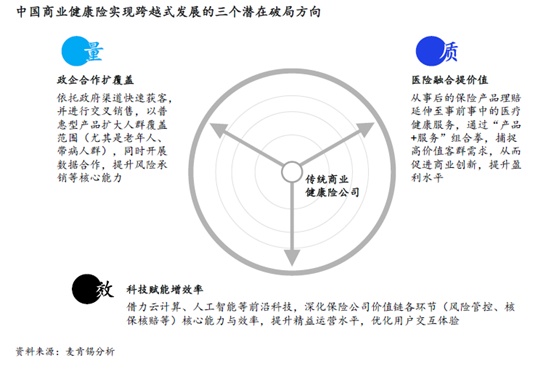
The following are the details extracted from the Report:

The present situation and predicament of commercial health insurance have different appearances and causes in different customer groups. At present, there are two main types of customers who buy commercial health insurance in the market: one is the customer who seeks the protection of medical expenses, and the other is the customer who pursues high-quality medical services. For the former, the most important function of commercial insurance is to hedge the risk of medical expenses and reduce the pressure of medical expenses; The latter is more inclined to obtain a better medical environment, better medical services and faster medical procedures by purchasing commercial insurance.
There are three main reasons for the insufficient development of health insurance for customers seeking medical expenditure protection:
1. From the demand side, the market demand of commercial health insurance in China has not been fully tapped. The overall cost of medical expenses is low, and the probability of catastrophic medical expenses is small, which leads to insufficient willingness and motivation of residents to purchase commercial insurance. At the same time, limited by market education, most residents lack due understanding of the coverage of basic medical insurance and the additional protection functions of commercial insurance.
2. From the perspective of supply and demand matching, the current market product supply cannot effectively stimulate potential demand. At present, there are many mismatches in mainstream health insurance products, such as "health care for healthy people does not guarantee non-standard", "medical insurance does not guarantee medical insurance outside" and "short-term insurance does not guarantee long-term", so it is often difficult for people who need the most protection to participate in insurance effectively.
3. From the supply side, in order to avoid the risk of compensation, the lack of core competence of insurance companies leads to their subjective screening of insurable people. Due to the short operation time of commercial health insurance, insufficient data accumulation and the insufficient development of medical service providers in China, insurance companies generally lack the core capabilities of deep integration with the medical service system, refined risk management and accurate capture of customer needs, which makes it difficult for them to develop products that stimulate market demand from the source.
For the customers who are pursuing high-quality medical services, although more and more residents are willing to pay for the upgrade of medical services, the number of such needs is still limited, which fails to effectively expand the scale of commercial medical insurance. The share of high-end medical services in the whole medical service market in China is less than 1%. The reason is that, from the perspective of ability to pay, high-income high-end medical consumers account for a low proportion of China’s total population; From the perspective of willingness to pay, the supply of high-end medical services in China is insufficient, and public hospitals are still the first choice for most residents to seek medical services.
In addition, some characteristics of China’s medical system have also brought challenges to the development of commercial insurance. For example, the insured population of basic medical insurance and the commercial insurance guarantee population overlap a lot, and the boundary of guarantee treatment is not clear; Medical service providers are mainly scattered public hospitals, and commercial insurance companies have limited influence on them; The foundation of medical and health data is relatively weak, and there is no integrated structured data platform.
In view of the above analysis, the Report finally gives insurance companies three solutions to promote the break of commercial health insurance:
Path one
Extending from the core diagnosis and treatment in an all-round way, exploring a new model of medical insurance integration
In the current medical ecology of China, commercial health insurance mainly plays a simple role as a payer, and most of the medical compensation resources are concentrated in the treatment link, which has not yet achieved the full health journey coverage of prevention in advance and management afterwards. At the same time, medical insurance settlement is often passive, and the participation in the formulation and implementation of medical service plans is low. In order to get rid of the dilemma of limited value creation and insufficient ecological impact, commercial health insurance companies should actively extend from today’s point layout horizontally along the patient’s health journey and vertically along the medical service network to create a "product+service" that runs through the whole medical life cycle.
Extend horizontally along the patient’s health journey to meet the needs of health services throughout the life cycle.
Health management services can create two types of value for insurance companies.
First, medical value: through professional, preventive and active intervention of sub-health and chronic patients, the risk of potential diseases can be effectively reduced, the disease progress can be delayed, and the compensation cost can be reasonably controlled;
Second, the value of service: by providing professional and service-oriented medical butler experience, we can meet and coordinate the health-related needs of customers (such as diet and drug use consultation), increase user contacts, and help customers get additional insurance. On this basis, health insurance companies can also interact with users regularly, screen and accumulate valuable health data of users throughout their life cycle, and create a starting point for subsequent product innovation and operational improvement.
Of course, from a global perspective, due to the differences in their own positioning, the core demands for value creation are naturally different.
The commercial insurance system in the United States is very mature, and the pressure of medical cost is mainly borne by insurance companies. Therefore, reducing the compensation cost is the most important appeal of insurance companies.
Considering that commercial insurance in the United States is mostly group insurance, it is difficult to achieve large-scale customer acquisition only by service value. As the most important payer, commercial insurance bears the main pressure of medical cost, so it becomes its fundamental appeal to help reduce the medical value of compensation. At the same time, the health insurance system with group insurance as the main body in the United States is difficult to get customers only by service value, but health management service, as a starting point to incite user stickiness and medication compliance, is conducive to the realization of medical value.
Throughout the American market, the emergence of chronic diseases and health management service companies such as Livongo and Omada has benefited many insurance companies. Their professional solutions can effectively improve the health status of patients and help insurance companies and employers save medical costs.
In Britain, Germany and Singapore, social security is the main body, and commercial insurance mainly plays a supplementary role. As the fundamental guarantee and main payer of residents’ medical needs, social security leads to the establishment of basic chronic disease management systems at the national level, relying on the public medical system (such as NHS chronic disease management plan in Britain and CDMP plan in Singapore).
In recent years, many countries with social security as the main body have launched innovative digital management schemes (such as Liva European government cooperation project), emphasizing the improvement of national health and reducing the overall medical expenditure. On the premise that the high-quality public system has fully guaranteed the medical value, commercial insurance, as an additional supplement, can focus on exploring the service value and take high-end management services as value-added items. For example, in order to meet the demands of different levels of customers for service value, Vitality has built a health management ecosystem, which permeates the daily life of members in all directions.
Professional health management services in China are in the initial stage, and the creation of medical value is not clear. All market players are trying to find a health and chronic disease management model suitable for China’s national conditions. Basic medical insurance in some areas is opening up chronic disease management funds, actively introducing professional chronic disease management solutions provided by commercial companies, systematically managing regional population health, and striving to improve people’s health status, save government medical insurance funds, and generate revenue from commercial companies’ services (such as provincial chronic disease management projects carried out by micro-medicine in Tianjin and Shandong).
Similarly, commercial insurance is also actively introducing medical ecological partners such as pharmaceutical machinery enterprises, sharing the cost of health management services based on the common goal of improving patients’ medication compliance, and improving the sustainability of model exploration. For example, Amway, a professional health service company, cooperated with JD.COM Allianz, Sanofi and other pharmaceutical companies to jointly launch "Zhen Ai Unlimited" diabetes insurance.
In view of the fact that China’s health insurance mainly focuses on C-end customers and the homogenization of insurance product design is serious, more and more insurance companies begin to explore differentiated value-added means from the perspective of health management, and strive to improve the ability of insurance companies to acquire customers and users. However, commercial insurance companies need to prioritize, pay attention to service value in the short term, and create differentiated competitive advantages. In the long term, they should actively explore medical value, reduce medical costs, expand the coverage of sick people, and achieve revenue growth.
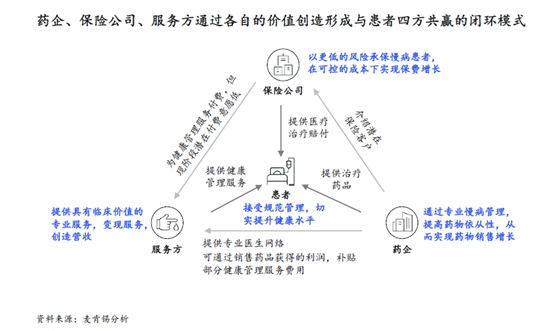
Specifically, insurance companies can extend forward and backward along the life cycle and diagnosis and treatment links of the insured, and build an end-to-end health management service system, including four aspects:
First, health management covers the whole cycle from health education, monitoring and evaluation to health intervention and tracking, such as diet, exercise and sleep management, so as to reduce the possibility and risk of illness;
Second, sub-health management, aiming at sub-health groups such as urban white-collar workers, comprehensively manages physiology and psychology, such as psychological counseling and TCM conditioning;
Third, the diagnosis and treatment of diseases, to create an all-round, multi-level and high-quality medical service system for the health needs of different customers in different scenarios;
Fourth, chronic disease management, including regular detection, continuous monitoring, evaluation and comprehensive intervention management of chronic diseases and risk factors, to speed up the recovery of diseases or reduce the risk of disease progression or recurrence.
In order to meet the health care and professional medical needs of users, insurance companies should focus on the core competence building in five areas:
1. Professional doctor team: As an important medical resource, professional doctors are responsible for users’ daily health status, regular diagnosis of common diseases, and meeting key medical needs such as treatment. Through online platforms and other tools, a highly accessible team of doctors can provide convenient medical services such as long-distance regular follow-up visits, interpretation of data indicators, and guidance on the dynamic adjustment of patients’ prescriptions.
2. Full-time service personnel: A service team with professional medical background is the core element connecting all aspects of health management services (such as diagnosis and treatment to after-the-fact management), as well as front-end users and relevant parties in the back-end medical ecology, and reflects service value and medical value with timeliness and professionalism.
3. Regular inspection and testing: through various inspection contacts such as home intelligent hardware, professional inspection institutions, and in-hospital medical testing, an all-round and real-time updated medical and health database around individual patients is constructed, forming a data base for disease treatment and health management scheme treatment of medical service personnel.
4. Drugs for chronic diseases: Professional drug list and customized drug scheme audit can improve the treatment effect and control the treatment cost. Convenient prescription renewal and distribution process can improve the service experience and compliance of patients.
5. User-inspired operation: service detail design based on user’s needs and experience, business process of organic integration between online and offline and functional modules, multi-touch, attractive and penetrating into all aspects of life, and convenient and easy-to-use digital tools are all important underlying foundations for realizing health management services.
On the basis of having five core competencies, insurance companies also need to build Unicom’s data application system, and record medical and service behaviors through a set of electronic files throughout the user’s life cycle and the whole diagnosis and treatment cycle; As well as effective organizational mechanisms and processes, to build the underlying guarantee and capacity foundation for the cooperation of all ecological stakeholders.
In addition to self-construction, the external medical ecology also provides rich choices for insurance companies seeking different breadth and depth of cooperation: professional chronic disease management service companies focusing on specific disease areas and opening up all aspects of health management in one stop; By grasping the core medical resources (specialists in various fields), the Internet hospital platform is specialized in consulting and treating key medical services; Vertical service providers who focus on specific links (such as drug distribution, inspection and testing, specific health management services, etc.).
For health insurance companies, the feasibility and necessity of acquiring the five core competencies are different, and the optimal development and cooperation model should be selected in full combination with their own characteristics (such as internal asset layout and strategic positioning of health undertakings).
Extend vertically along the medical service network and build a multi-level and deeply integrated institutional network.
In order to better undertake and meet the medical needs of users, health insurance companies should get rid of the positioning of passively participating in the post-settlement link of medical services as payers, focus on pre-influencing, and actively participate in the provision and decision-making link of medical services. Through more in-depth cooperation with the medical service network, the diagnosis and treatment behavior of the service network can be effectively standardized, so as to achieve the multiple purposes of ensuring the quality of medical services, improving the effect of medical treatment and controlling medical costs.
Of course, when designing and building an institutional network, insurance companies should also consider the differentiated needs of patients in the whole health journey (such as incurable diseases, daily check-ups, health management, etc.) to achieve a multi-level and deeply integrated layout:
1. Flagship hospital: a national and regional key hospital with high influence, representing the top clinical level in China. Flagship hospitals can meet patients’ critical medical needs, but resources are scarce and irreplaceable in a few medical scenarios (such as the diagnosis of intractable diseases).
2. Key hospitals: public hospitals ranked in the top places and private hospitals with relatively large business scale. Key hospitals undertake most of the daily medical needs and are the key components of the medical network.
3. Small and medium-sized medical institutions (including clinics, health management centers, etc.): they mainly undertake simple and routine basic medical care and provide daily health management services, which is an indispensable part of completing the process medical needs.
Looking back on the development of the world’s leading health insurance companies, it is an inevitable trend to cooperate and link with the medical network more and more closely. From the close degree of cooperation, the medical network management of insurance enterprises is divided into four modes from light to heavy:
1. Non-specific network
This model is common in China market at this stage. Insurance companies have no designated or preferred service organizations, and there is only a payment relationship between insurance and medical network. This model requires low professional ability and cost input, and it is difficult to build product differentiation competitiveness and profitability.
2. Sign up for cooperation
In this mode, insurance companies will sign a specific external service network, discuss the service scope and price, and begin to provide differentiated customized services to insurance members. This model represents the development trend of commercial health insurance all over the world and belongs to the basic concept of PPO optimal medical network in the United States. Aetna, mentioned above, has built one of the largest medical networks in the United States through a mutually beneficial and win-win payment model and the ability to export patient data and service standards.
3. Internal and external integration
This model belongs to the upgraded version of the former, mainly based on the external cooperation network to establish internal institutions to supplement the types and links of services. Insurance companies can further deepen differentiated services and form a unique competitive advantage with the help of strong control over their own institutions. For example, based on the external network, United Healthcare supplements its own medical network focusing on primary, specialized and emergency care. Together with the external network, these core advantages form a closed loop of health management. The internal and external networks are connected by the care coordination center to realize the integration of online and offline medical services and internal and external medical services, and to create a one-stop health solution.
4. Self-built operation
The medical network in this mode is directly established or managed by insurance companies, and there is a strong binding relationship between payment and service. The whole insurance medical service ecology is closed. However, this model requires excellent network operation qualification, operation ability and sufficient resources, which is the biggest challenge for insurance companies. In addition, considering that the medical service market in China is still dominated by the public system, it is difficult for insurance companies to build their own medical service network, and the applicability of this model is not high.
As mentioned above, China’s medical system is dominated by public institutions, and it is difficult for insurance companies to build their own medical networks. However, China Health Insurance Company is actively exploring the transformation to contract cooperation, internal and external cooperation network and other modes, striving to create value for core medical institutions, complement internal medical capabilities in a misplaced manner, and deepen the differences of insurance products.
In the short term, we will focus on building an external hospital network with wide coverage, high quality and in-depth cooperation. Starting from key hospitals at all levels, we will jointly explore the value creation points through efficient cooperation and negotiation (such as value-oriented payment mode and high-end customer diversion); Export standardized hospital management capabilities (such as lean operation, academic research, digital system) to attract cooperation between large public and private hospitals. In terms of medical resource supply and service quality, we should work together to create a differentiated competitive advantage of insurance products.
In the long run, we should internalize the medical service ability and improve the service system. Through operation trusteeship, we deeply participate in the daily management of some private and small and medium-sized hospitals, and deeply implant insurance service scenarios while improving hospital operation performance; Insurance companies can also choose to invest heavily in assets, invest or build their own customized medical services for insurance products. In addition to deep integration with insurance products, internal institutions also need to strengthen cooperation with external hospitals to form an organic supplement and close linkage, and build a complete diagnosis and treatment service network.
Path 2
Taking risk management as the center, constructing a refined insurance operation system
The lack of risk protection ability is an urgent challenge for commercial health insurance in China. The most intuitive embodiment is the "one size fits all" model of mainstream products in the market, which excludes all sick and non-standard people from the scope of protection.
For insurance companies, strengthening risk management capacity building, effectively improving the scientificity and accuracy of insurance product design, and building an end-to-end refined operation system are the keys to building future core competitiveness. Breakers are expected to take the lead in cutting into the huge market of people with diseases, significantly expand the scope of insurable people and increase operating income under the premise of accurately controlling risks.
At the same time, customized products and services based on the risk insights of segmented people will further enhance the premium and profitability of insurance products.
Cooperate in mining high-quality medical data to lay a solid foundation for risk management.
The lack of medical data is the fundamental reason for the lack of risk protection ability of insurance companies. On the one hand, building a refined population risk stratification model requires high-quality medical data; On the other hand, the current empirical data of insurance companies are insufficient, and the existing data have not formed a structured system, which has failed to achieve deep mining.
In order to cultivate risk management and control capabilities, insurance companies urgently need to build a refined crowd risk stratification model based on big data. Model training data should meet five basic requirements:
(1) The sample has a certain scale and effectively covers the target population;
(2) The selection of samples is random and representative, which can effectively reflect the risk characteristics of the people to be insured;
(3) The sample data need to cover both the risk causes (such as mild diseases) and the risk results (such as the diagnosis of serious diseases) in order to establish an effective causal prediction relationship;
(4) The sample data should be continuous and complete to ensure that the relevant risk causes can be effectively captured;
(5) In addition to the qualitative diagnosis results, the sample data should also include specific medical expenses to quantify the risks.
Compared with the high-quality data required by the crowd risk stratification model, there are many defects in the insurance company’s own data. First of all, due to the short start-up time of health insurance in China, the few claims of young healthy people and the low market penetration rate of compensation products, the effective medical data accumulation has not reached a scale. Secondly, insurance companies only know the diagnosis results of claims, and lack specific data on related risk factors or treatment costs. Moreover, health insurance in China is mainly short-term products, and the continuity of medical data is poor. Once users change products or stop buying, it will cause medical data fault. Finally, the claim data can only reflect the current risk profile of the insured customers, and it is difficult to form meaningful guidance and prediction for future medical risks.
Based on the above objective challenges and the limitations of internal capabilities, it is difficult for insurance companies to quickly establish core risk control capabilities with their own data in the short term. Major health insurance companies have explored legal, compliant, large-scale and systematic medical data acquisition modes, including data cooperation with the government and obtaining medical data through the hospital system.
1. Cooperate with the government on data.
Different types of insurance companies can rely on their own endowment to explore innovative cooperation models with the government in order to obtain medical data with commercial value. Leading enterprises with scale advantages can actively participate in the construction of national medical security system by handling basic medical insurance and undertaking Huimin insurance. Start-ups can lock in certain sub-sectors (such as rare diseases), rely on their own professional data capabilities, cooperate with the government, and explore innovative applications of medical data through small-scale pilots.
2. Get medical data through hospital channels.
Commercial insurance companies are actively mining medical data from hospitals. With the help of claims, some insurance companies have opened the electronic case system of cooperative hospitals, allowing access to customers’ complete in-hospital diagnosis and treatment data; There are also some insurance companies that are cooperating with medical information service providers to obtain desensitized medical data or insights. It is worth mentioning that the head insurance company is trying to accumulate patient data through the self-built hospital system. Although the data acquisition at this stage has not yet formed a scale, with the accumulation of time, it is expected to form a large-scale and high-value patient medical database.
Empowering the innovation of insurance full value chain with refined risk management and control ability
Referring to the development of developed countries in Europe and America and the successful experience of some domestic advanced pilot projects, we find that the quantitative risk stratification model established by using multi-dimensional (including basic population information, medical data and insurance claims data) and large-scale (representative city level) medical risk factor data has a wide application prospect, covering health insurance product design, insurance underwriting, medical services, claims management and other aspects of the industrial chain. We will combine domestic and international leading practices to introduce the highlights of application cases of key value chain links of health insurance for industry reference.
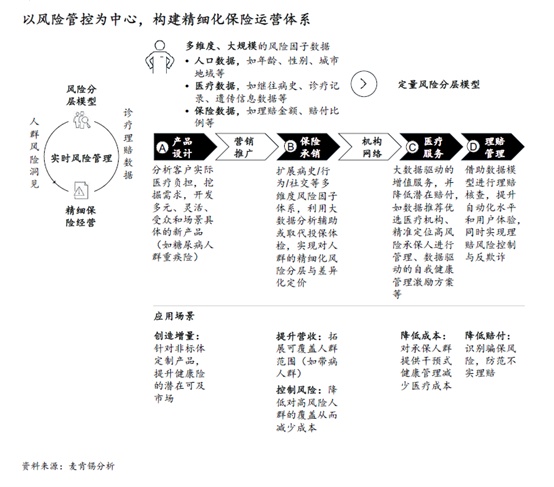
Domestic case: Establish a risk stratification model to improve the performance and efficiency of insurance underwriting.
Taking the underwriting link of the insurance core as an example, in the traditional insurance business process, the pursuit of comprehensive information as much as possible easily leads to pain points such as complicated process, poor experience of policyholders, inefficient information collection and poor quality. The underwriting decision-making is too standardized and lacks customization, which can not accurately reflect the health risks of individual policyholders. At the same time, insurance companies need to invest a lot of offline underwriting resources by relying on the risk exemption form that the insured voluntarily informs or falsely informs the risk.
Through the risk analysis of big data population, we can identify the predictive factors (such as lifestyle preferences) that are highly related to the occurrence and payment of diseases, and establish an accurate underwriting model for health insurance. Based on the individual information of the insured (such as age, past medical records, etc.), the health risk score is automatically generated and compared with the regional average score to form a refined quantitative risk assessment. Based on the underwriting score, the crowd is finely stratified to form a "black and white list". For example, step-by-step pricing is adopted for high-risk groups, and manual review is conducted; For low-risk people, a rapid underwriting process is adopted to improve efficiency.
We use the risk prediction model to measure the simulated insured population, which not only simplifies the underwriting process of 50% population, but also adjusts the underwriting decision through the identified high-risk population, thus reducing the potential compensation by 10%~15%. The risk prediction model has achieved important business value, and it is a classic use case to upgrade the insurance claims service experience and reduce the medical cost.
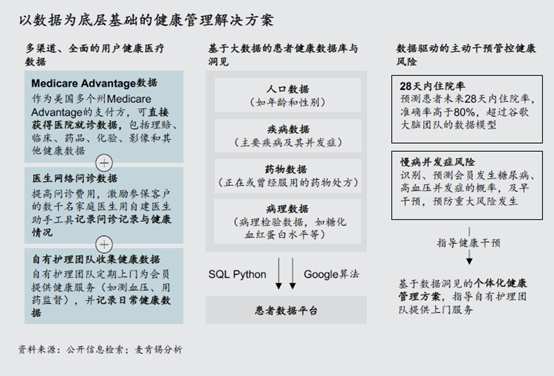
International case: establish a risk-driven health management scheme with data as the core to improve medical effects and reduce costs.
Take an insurance company in the United States that focuses on Medicare products as an example. Because Medicare customers are mainly elderly people, users’ medical service costs are high, especially for chronic diseases and their complications, which often account for a large proportion of medical claims. In order to alleviate the pressure of medical claims, the company relies on the advantages of core data to collect all-round user health medical data through MA insurance data, doctor network and self-built team health services. At the same time, relying on Google’s advanced algorithm platform, an insight analysis database of complex patient health data is established. Based on this, the company developed and implemented a patient-active intervention health risk management and control solution.
Accurate intervention behavior has achieved remarkable results. The insurance company has successfully improved the management effect of chronic diseases, reduced the hospitalization rate of elderly patients by 30% while reducing costs and expenses, and greatly improved the disease control rate of patients with diabetes and hypertension.
Path three
Remodeling the whole process of product design and sales around customer needs and experiences.
With the rise of "personal consumption consciousness" in the global health industry, consumers have begun to play an increasingly important role in the decision-making of health payment. Whether it can more accurately meet the needs of different segments of people (such as the elderly, the sick, the high-income people, etc.) and different levels (such as basic medical care, service experience, etc.) has become the key to solve the serious homogenization of health insurance products in China today.
The product design, marketing promotion and experience shaping with customer demand as the core indicate that the health insurance industry in China has undergone a comprehensive transformation from the barbaric growth stage of "sales is king" to the era of "demand-oriented" value operation.
Grasping customer demand and recreating product form
The homogenization problem of health insurance products in China is serious, and the insurance clauses are highly similar to those of insurable people. Standardized basic products are difficult to meet the different medical needs of different segments of people in different scenarios, and it is even more difficult to achieve differentiated value creation, which leads to the fact that today’s health insurance sales basically rely on channel capabilities and price competition is fierce. In the future, it will be the key for health insurance companies to create differentiated advantages, enhance product value and market penetration by building product innovation capabilities driven by user needs.
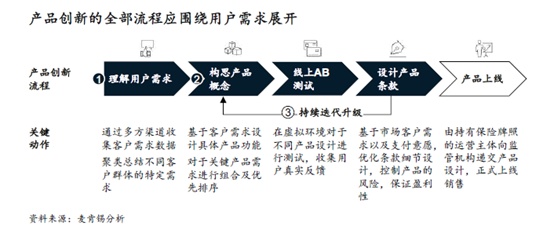
In the process of product innovation, customer insight, product system and continuous iteration are the three core elements of demand-driven product innovation.
First of all, digging deep into customer needs is a key first step. With the help of systematic research tools, insurance companies can divide the customer groups into groups of people, scenes and life stages, and deeply understand the needs of users for medical care, health and services;
Secondly, insurance companies need to draw a comprehensive functional map of innovative products, sort out the existing product positioning in the internal system, and comprehensively collect the best practices of industry product functions and use cases;
Finally, the organizational level needs to establish innovative process mechanisms and underlying capabilities to support rapid product iteration and achieve accurate matching between customer needs and product functions.
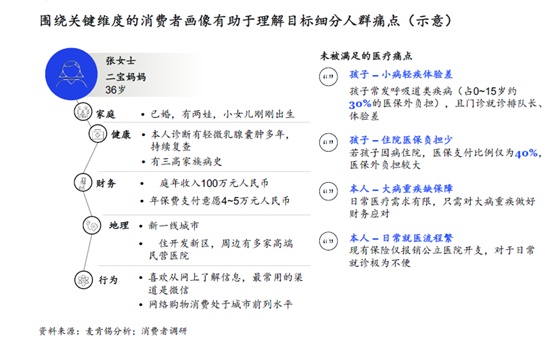
(A) customer insights
Demand insights from multiple channels and all directions are the foundation of refined product design. Externally, design a scientific questionnaire, and under the guidance of mature system methodology, gain a deep insight into the unmet needs of health insurance customers. Internally, cultivate the concept and consciousness of customer-centered sales system, and carry out active and systematic collection of user demand information to consolidate the data foundation. Combined with external industry research and internal sales insights, the characteristics of target customer groups are generated, and unmet medical needs are identified, which provides important guidance for product innovation.
(2) Product system
Identify the potential development direction of products based on internal combing and external benchmarking product system. Internally, define the strategic positioning of products and core businesses, set subdivision dimensions in key categories such as revenue creation, market capture and customer service, and identify unmet opportunities through quantitative evaluation. Externally, pay close attention to major competitors and market-leading enterprises, understand their layout in major innovation directions such as coverage, coverage, coverage period and disease types, and build a rich industry intelligence database. On the basis of fully understanding the demand side, systematically build a supply-side "arsenal".
(3) Continuous iteration
Fast iterative optimization based on real customer feedback to maximize product innovation value. Traditional insurance companies urgently need agile transformation, introduce multi-functional collaborative teams (such as development, sales and actuarial personnel), and set up special posts for customers’ needs to ensure that customer feedback falls into product development; In addition, we should abandon the traditional assembly line product development process and form a "sprint" work cycle with small steps and quick runs, flexibly adjust the direction of product development, improve efficiency and avoid waste of resources.
Excavate high potential customers and realize precise marketing.
Similar to other insurance products, China Health Insurance relies heavily on offline agent team to promote sales with indiscriminate recommendation, which often leads to opaque product information, untimely communication and poor customer experience. If we can achieve accurate marketing based on users’ needs and preferences, we can effectively solve the pain points, and effectively improve the efficiency and success rate of customer sales transformation through thousands of customized promotion programs.
Precision marketing has important business value for old customer operation and new customer mining. On the one hand, by identifying high-risk customers and high-value customers and taking precise intervention, we can effectively prevent the loss of old customers and tap the potential of new customers; On the other hand, screening high-potential customers with willingness and possibility to purchase health insurance among existing insurance customers (such as life insurance and property insurance) to improve the success rate of cross-selling; In addition, innovative distribution channels (such as Internet channels) should be developed, and marketing schemes that meet the target customers of the channels should be formulated, so as to expand the scale of new customers.
Establishing a multi-dimensional user database, including demographics and marketing feedback, is the basis for achieving precision marketing. On this basis, insurance companies can further overlay claims information covering patient treatment plans and related medical costs. Different from general operating data, claims data has a large information content and a high degree of professionalism, which requires insurance companies to have both digital marketing and professional medical capabilities. Accordingly, the core insight of the database can guide the business development more intuitively and bring higher business growth value.
Precision marketing can be divided into three steps: high-potential customer identification, customized scheme design and effective implementation and promotion.
(1) Identification of high-potential customers
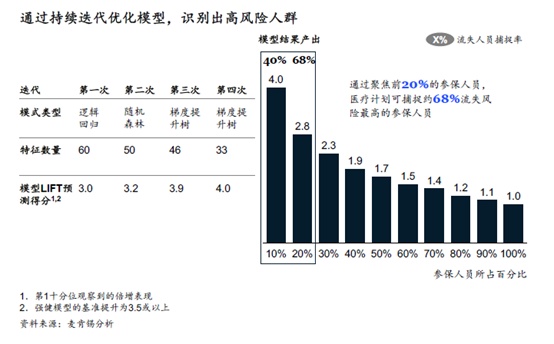
The essence of precision marketing is to identify high-potential customers and their preferred marketing contents and methods. As mentioned above, the establishment of multidimensional database is helpful to identify key potential customers and predict risk factors, so as to find out key target customers with high potential. The optimized algorithm will recommend the most suitable health products according to the background and needs of consumers, and then iterate the best marketing content through AB testing and other methods. Finally, use online and offline marketing channel tools (such as WeChat, telephone, offline visits, physical advertisements, etc.) to clarify the most effective way to interact with target customers.
(2) Customized scheme design
After fully understanding the preferences of target customers for marketing content and methods, insurance companies can start to formulate all-round marketing interaction programs. From scattered "individual combat" to systematic "marketing promotion combination boxing", we can create synergy between channels, avoid resource waste and improve marketing efficiency.
(3) Effective promotion and implementation
The effective implementation of customized marketing plan can not be separated from dynamic management. Based on dynamically generated quantitative effect feedback, insurance companies can optimize the scheme in real time and adjust the established scheme. The insight of marketing data can provide key input for many business scenarios, such as internal sales staff management, marketing expense planning, product design innovation and so on.
Driven by digitalization, recreating end-to-end user experience
Previously, due to the mismatch between users and payers of health care, the industry did not focus on user experience. In view of the increasing importance of consumers in medical decision-making, more and more enterprises are taking user experience into important strategic consideration and increasing resource input. User experience optimization is not only a customer-oriented service upgrade, but also brings commercial value to insurance companies, such as reducing customer churn, improving new customer acquisition, and increasing service bargaining.
In this link, insurance companies need to focus on three major areas:
(A) Understanding user needs is the basis and foothold of reshaping user experience.
Insurance companies should use scientific methods and tools to deeply understand users’ experience feedback on product rights, process tools and manual services. At the same time, for key links, we will dig deep into the feedback of segmentation process and finely polish user satisfaction. Then, with the update of product form, the feedback of user experience is collected in real time to further optimize product iteration.
(B) emphasizing the "user experience" of organizational transformation and upgrading
First of all, we should emphasize the importance of user experience from the company strategy, build cross-departmental value recognition, and take it as an important direction to guide business development. At the same time, we will increase the input of relevant resources to enhance the user experience, and promote the transformation of products, services, experiences and business models aimed at it. Finally, the internal core competence is established to support the transformation, such as employee concept transformation and ability training, strengthening technical, data and analysis support, establishing cross-functional governance and agile operation mode, and deploying measurement and performance management systems.
(C) Make full use of digital empowerment to achieve a leap-forward upgrade of user experience.
Using modern scientific and technological tools such as Internet platform, mobile App and AI computing, we will focus on solving the inherent pain points such as complex and inefficient traditional insurance sales and service processes, and create an efficient, convenient and easy-to-use modern insurance experience.
This article was first published on WeChat WeChat official account: Huibao Tianxia. The content of the article belongs to the author’s personal opinion and does not represent Hexun.com’s position. Investors should operate accordingly, at their own risk.