Multidisciplinary Expert Consensus on Heart Rate Management of Hypertension Patients in China (2021 Edition)
Increased heart rate is a common clinical phenotype of hypertension. The survey shows that the resting average heart rate of patients with hypertension in China is 76.6 beats /min, and the heart rate of patients with simple hypertension is ≥ 80 beats /min, accounting for 38.2%. In recent years, the heart rate management of patients with hypertension and increased heart rate has been paid more and more attention, because many epidemiological studies in different populations show that increased heart rate is likely to be an important cardiovascular risk factor, which can increase the risk of cardiovascular events and death.
Multi-disciplinary Expert Consensus on Heart Rate Management of Hypertension Patients in China (2021 Edition) systematically introduces the purpose, significance and methods of heart rate management of hypertension patients, and adds related contents of cardiology, neurology, endocrinology, nephrology, geriatrics, pharmacy and other clinical disciplines, so as to provide guidance for doctors in various disciplines to manage heart rate for different types of hypertension patients.
Heart rate measurement in patients with hypertension
Heart rate can be measured by pulse palpation, cardiac auscultation, electronic sphygmomanometer, electrocardiogram, ambulatory electrocardiogram or ambulatory blood pressure. When arrhythmia, especially atrial fibrillation, pulse palpation, electronic sphygmomanometer or ambulatory blood pressure measurement may cause errors, so it is recommended to count the heart rate through cardiac auscultation. The heart auscultation time of patients with atrial fibrillation should last at least 1 min.
1) Heart rate in clinic
The heart rate was counted by pulse palpation and auscultation. The factors affecting heart rate include physiological factors, psychological factors, environment and body position. In order to minimize the influence of the above factors, the measurement of resting heart rate should be standardized (Table 1). Heart rate in clinic is the most commonly used way to measure heart rate. Therefore, resting heart rate in this consensus generally refers to that measured in clinic.
Table 1 Suggestions for measuring resting heart rate in consulting room
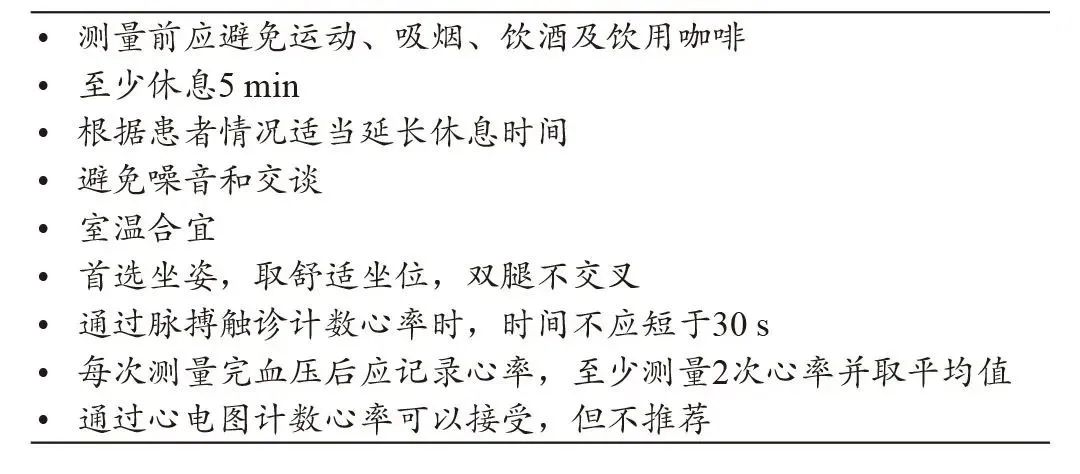
2) Home self-test heart rate
Family self-rated heart rate has a good correlation with clinic heart rate and 24 h average heart rate. It is suggested that patients record their heart rate while measuring their blood pressure with a home automatic sphygmomanometer, and try to test their heart rate in the quiet state in the morning as much as possible. Please refer to Table 1 for the precautions during measurement. Family self-rated heart rate may provide more valuable information for clinic and avoid white coat effect, but the research on the relationship between family self-rated heart rate and adverse events is limited. Hozawa et al reported that the risk of cardiovascular death increased by 17% for every 5 times /min increase in family self-rated heart rate (P = 0.004, with an average follow-up of 10.5 years).
3) Dynamic heart rate monitoring
It can be obtained by 24 h ambulatory electrocardiogram and ambulatory blood pressure measurement. Compared with the heart rate in clinic, ambulatory heart rate can provide more valuable information for clinic, including the circadian rhythm of heart rate, heart rate variability, night heart rate and avoiding white coat effect. Many studies have shown that there is no significant difference between the 24-hour average heart rate of hypertension or the general population and the heart rate of the clinic, but some studies have found that the 24-hour average heart rate is lower than that of the clinic. For example, in 807 elderly patients with isolated systolic hypertension, the 24-hour average heart rate was (3.8 8.0) beats/min slower than that in the clinic (P < 0.001).
Too fast heart rate at night usually reflects the enhancement of sympathetic nerve activity at night, and the predictive value of average heart rate at night for cardiovascular events and death risk is better than that at daytime. The increase of blood pressure and heart rate in the morning may increase the risk of cardiovascular and cerebrovascular events.
4) Wearable heart rate detection equipment
Wearable medical devices have developed rapidly in recent years. By using optical plethysmography and other technologies, many smart phones, watches and bracelets can provide the function of real-time monitoring of heart rate at rest and during exercise. Preliminary research shows that the heart rate measured by these wearable devices is in good agreement with the data recorded by synchronous electrocardiogram, but its clinical application value needs further study.
Tangent point and method of heart rate intervention in patients with hypertension
This consensus expert group comprehensively analyzes the existing evidence-based medicine evidence, and refers to the opinions of the European Hypertension Society, suggesting that the cut-off point of heart rate intervention for hypertensive patients in China should be defined as resting heart rate > 80.Times /min. At the same time, this consensus also suggests that many home self-rated heart rates of hypertensive patients at rest at different time points are all above 75.Times /minTimes /minIt can also be regarded as an increase in heart rate.
In addition, this consensus also puts forward a standardized diagnosis and treatment process for heart rate management of hypertensive patients (Table 2):
1) Investigate the causes and causes of rapid heart rate increase, and correct and treat the influencing factors and primary diseases.
2) Improve the unhealthy lifestyle.
3) Beta blockers, an antihypertensive drug with the effects of slowing down the heart rate and reducing the excitability of sympathetic nerves, are the first choice for drug treatment, especially the selectivity of cardiovascular protection confirmed in clinical trials.βoneReceptor blockers-metoprolol sustained-release tablets and bisoprolol.
Those whose blood pressure is not up to standard can be combined with dihydropyridine calcium antagonists and other antihypertensive drugs when necessary until their blood pressure and heart rate are up to standard.
Table 2 Flow chart of heart rate management in patients with hypertension
Heart rate management of hypertension complicated with special diseases
Active blood pressure reduction can prevent or delay the occurrence and development of heart failure, and the blood pressure should be controlled at < <130/80 mmHg. Patients with hypertension complicated with heart failure often manifest as heart failure with preserved ejection fraction (HFpEF) or heart failure with reduced ejection fraction (HFrEF), especially in patients with coronary heart disease.
For HFrEF patients with sinus rhythm, it is suggested to control resting heart rate < 70 beats /min when blood pressure can be tolerated, and beta blockers (bisoprolol, metoprolol sustained-release tablets or carvedilol) should be the first choice. For patients who can’t reach the target rate or can’t tolerate beta blockers, ivabradine is recommended to further reduce the hospitalization rate of heart failure and the mortality rate of cardiovascular diseases.
At present, patients with HFpEF are treated with comprehensive treatment aiming at the etiology, symptoms, complications and risk factors.A small number of patients with HFpEF have decreased heart rate reserve (that is, cardiac chronotropic insufficiency, and the heart rate cannot be increased accordingly during exercise). These patients should start with small doses of β -blockers and observe their adaptation.For most patients with HFpEF, beta blockers are still one of the preferred drugs for blood pressure and heart rate management, especially for patients with atrial fibrillation or fatigue angina pectoris with sinus tachycardia and fast ventricular rate.
Hypertensive heart disease complicated with chronic atrial fibrillation should follow the corresponding atrial fibrillation guidelines. Ventricular rate control is one of the main strategies of atrial fibrillation management, which can obviously improve the symptoms of patients. Commonly used drugs are beta blockers, non-dihydropyridine CCB, digitalis and so on. Intravenous medication is generally needed to control ventricular rate in acute phase, and metoprolol, esmolol or diltiazem can be selected. Patients with acute heart failure can choose amiodarone or deacetyl lanatoside to control ventricular rate < 110 beats /min, and those with obvious symptoms can be controlled to 80 ~ 100 beats /min.
It is suggested that the resting heart rate of patients with stable coronary heart disease should be controlled at 55 ~ 60 beats /min. Controlling the heart rate in this range is helpful to reduce myocardial oxygen consumption, improve myocardial ischemia and stabilize atherosclerotic plaques. It is recommended to use highly selective β1 receptor blockers without intrinsic sympathomimetic activity, which can not only improve symptoms, but also may improve the prognosis of patients with coronary heart disease. For patients who can’t tolerate beta blockers or have contraindications to beta blockers, non-dihydropyridine CCB can be selected (when there are no contraindications to this kind of drugs). When the heart rate of patients with exertional angina pectoris is still uncontrollable after treatment with β -blockers or non-dihydropyridine CCB, ivabradine can be considered, especially for patients with HFrEF.
Actively control blood pressure and reduce ventricular contractility, and ensure tissue and organ perfusion as much as possible on the premise of preventing the expansion and tearing of the sandwich false cavity. In the acute phase, the systolic blood pressure should be controlled at 100 ~ 120mmhg and the heart rate at 50 ~ 60 beats /min as soon as possible. β1 receptor blocker (oral or intravenous administration) is the first choice for treatment, and vasodilators such as urapidil and sodium nitroprusside are combined. Different types of aortic dissection should be treated differently and individually.
Tachycardia and palpitation are common in most patients with hyperthyroidism, and the heart rate is usually 100 ~ 120 beats /min, which can reach 120 ~ 140 beats /min in severe cases, and the heart rate is faster when hyperthyroidism crisis occurs. Guidelines at home and abroad recommend the use of beta blockers in symptomatic hyperthyroidism patients, especially elderly patients, patients with resting heart rate > 90 beats /min or patients with cardiovascular diseases at the same time. For patients who are intolerant of beta blockers or have contraindications, non-dihydropyridine CCB verapamil or diltiazem can be used.
Diabetes patients are often accompanied by increased heart rate, which is accompanied by increased incidence of all-cause mortality and cardiovascular events. The reasons for the increase of heart rate in diabetic patients include cardiac autonomic neuropathy and imbalance of vagal-sympathetic nerve activity. The resting heart rate of diabetic patients should be maintained at 60 ~ 70 beats /min, and selective β1 receptor blockers or β and α1 receptor blockers with little effect on glucose metabolism should be used.
Pheochromocytoma and paraganglioma should be treated by surgery as soon as possible after diagnosis, and α receptor blockers should be the first choice for preoperative preparation to control hypertension. If the patient has tachycardia after using α-blockers, β-blockers are added to control the heart rate. It is worth noting that beta blockers should never be used before taking alpha blockers, otherwise it may lead to hypertensive crisis, acute pulmonary edema and left heart failure. If patients need to stop taking drugs, they should also stop taking beta blockers first and then stop taking alpha blockers.
Obesity is closely related to hypertension. Studies have shown that muscle sympathetic nerve activity is significantly enhanced in overweight and obese patients, and it is positively correlated with body mass index, waist-hip ratio and office blood pressure. In China population, the increase of resting heart rate is significantly correlated with the incidence of prehypertension and hypertension, and the combination of abdominal obesity will further enhance this correlation. Beta blockers are one of the commonly used antihypertensive drugs for obesity-related hypertension patients. When used in obese hypertension patients, the antihypertensive effect is stronger than that in normal weight hypertension patients.
Patients with chronic kidney disease (CKD) often have sympathetic nerve activation, and the sympathetic activity gradually increases with the decrease of renal function, accompanied by the accelerated progress of cardiovascular, metabolic and renal diseases. Beta blockers can be safely used in CKD patients with various degrees of renal dysfunction. Observational studies also suggest that beta blockers can significantly reduce the incidence of cardiovascular events and all-cause mortality in dialysis patients. This consensus expert group suggested that the resting heart rate of CKD patients should be controlled below 80 beats /min.
In the acute stage of hypertension complicated with hemorrhagic or ischemic stroke, there may be an imbalance between sympathetic nerve and parasympathetic nerve, that is, the excitability of sympathetic nerve is relatively increased, which leads to the change of heart rate. The clinical manifestations are rapid arrhythmia or alternating fast and slow heart rate changes. At this time, the cut-off point or goal of heart rate intervention is to maintain the stability of circulatory function.
If there is still abnormal heart rate after entering the recovery period of stroke, we can intervene according to the secondary prevention plan of stroke. A survey showed that with the increase of resting heart rate, the cognitive function of patients decreased significantly and the mortality rate increased significantly; Compared with the heart rate < 65 beats /min group, the all-cause mortality of patients in the heart rate subgroups of 77 ~ 82 beats /min and > 82 beats /min increased by 42% and 74% respectively (all P < 0.0001). Therefore, the resting heart rate of patients with ischemic stroke should also be controlled below 80 beats /min.
Hypertensive patients without cardiovascular complications (heart failure or coronary heart disease) should first emphasize the blood pressure reaching the standard and give consideration to heart rate management. In order to determine the level of hypertension or whether the resting heart rate is increasing, it should be based on the results of measuring blood pressure and heart rate three times on different days.
Summary of consensus outline: eight clinical suggestions
1、Hypertensive patients first emphasize the control of blood pressure to reach the standard, taking into account heart rate management.
2、All patients with hypertension should measure the resting heart rate in the consultation room at the same time as blood pressure measurement, and rest for at least 5 minutes before measurement. The measurement events in heart auscultation and pulse palpation should not be less than 30 seconds, and the heart auscultation time of patients with atrial fibrillation should last for at least 1 minute.
3、Resting heart rate > 80 in the consulting roomTimes /minAt that time, it is suggested that patients take home resting heart rate measurement to eliminate the white coat effect.
4、The breakthrough point of heart rate intervention for hypertensive patients in China is defined as resting heart rate > 80.Times /minFor patients with hypertension complicated with coronary heart disease, heart failure or aortic dissection, the heart rate should be controlled to the target heart rate according to the corresponding guidelines.
5、For patients with hypertension and increased resting heart rate, the basic diseases and other factors that cause increased heart rate should be investigated first, and if they exist, the primary diseases and inducing factors should be treated first.
6、Effective lifestyle intervention should be carried out in patients with hypertension and rapid heart rate.
7、For patients with hypertension and increased resting heart rate, especially those with coronary heart disease, heart failure, aortic dissection and rapid atrial fibrillation, drugs with both antihypertensive and heart rate control effects can be selected, such as beta blockers. Those who cannot tolerate beta blockers can choose non-dihydropyridine calcium antagonists (HFrEF is prohibited). Attention should be paid to the adverse reactions and contraindications of drugs.
8、Priority is given to the selection of long-acting β1 receptor blockers with high cardiac selectivity, and β 1 receptor blockers and α1 receptor blockers are recommended for patients with obesity, hyperglycemia and dyslipidemia.
[1] China multi-disciplinary expert consensus on heart rate management of patients with hypertension (2021 edition) [J]. China Medical Frontier Journal (electronic edition), 2021,13(4)